Free shipping – Breakage protection included – No minimum order
Timeless symbol of refinement, a crystal lamp captures light and transforms it into a dazzling play of reflections… something ordinary glass can ever match.
A table lamp for your living room, a floor lamp for your reading corner, a discreet wall sconce for a hallway or bedside: each type of crystal lamp has its own characteristics and uses.
But they all share one thing in common: an unrivalled purity of material and precision of cutting that only two countries can still truly claim to uphold… France and the Czech Republic, with its historic Bohemia region.
Looking for a chandelier to complete your interior ? Explore our curated selection of crystal chandeliers.
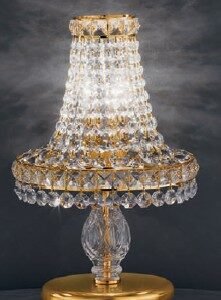
Showing the single result
If you’re on this page, you probably already have some idea of the answer to that question.
But allow us to share our answer, which comes down to 3 main reasons:
Reason no. 1 (the most obvious): The quality of the light
A crystal lamp stands out for the way it diffuses light. How? Because its refractive index (around 1.55) is significantly higher than that of ordinary glass (around 1.50). The result? With the same bulb wattage, the way crystal disperses light multiplies its brilliance, producing the characteristic bluish flashes and shimmering reflections of crystal.
Reason no. 2: Its value as a heritage piece
There are two schools of thought here: its value as an investment and its value as something to pass down.
As an investment? Absolutely. From a heritage perspective, crystal lamps stand apart from other lighting fixtures. An antique lamp signed by a renowned crystal manufacturer can retain, or even increase, its value over time. Something no ordinary glass lamp can promise.
Now, if we’re being honest, we favour the second school of thought: the value of passing something down. Because a crystal lamp (like any other crystal object, for that matter) makes a wonderful heirloom, one that can be passed from generation to generation. Thanks to the unique craftsmanship behind its creation, the prestige associated with crystal and its incomparable beauty… a crystal lamp will look just as at home on your children’s or grandchildren’s sideboard. It’s a powerful sense of heritage that ordinary glass, once again, simply cannot offer.
Reason no. 3: It’s a statement piece
Finally, from a decorative point of view, a crystal lamp sets the tone of a room and gives structure to your interior… even when switched off! Its strong visual presence comes from the depth of the material itself, which plays just as beautifully with ambient lighting as it does with daylight reflections.
And the style? There’s something for everyone! Classical hand-cut designs (Louis XV, Louis XVI, Empire) will anchor a traditional, heritage-inspired interior. Art Deco pieces from the 1920s and 1930s (geometric forms, symmetrical patterns) bring, for their part, a distinctive graphic character. And contemporary creations play on the contrast between a noble material and clean, minimalist lines.
One material. Three aesthetic styles that allow your crystal lamp to fit just as naturally into a Haussmann-style Parisian apartment as into modern architecture.
A centrepiece for a living room or bedroom, a crystal table lamp generally stands between 30 and 60 cm tall (base + lampshade).
Its purpose?
To provide accent and atmospheric lighting, rather than serve as the main light source.
So it’s perfectly suited to:
– An entrance hall console table.
– A side table.
– A bedside table.
– A sideboard.
– Or even a desk.
You can also buy them in pairs to create symmetry on a piece of furniture (a sideboard, for example). If you do, simply keep the difference in height between the two lamps to a maximum of 5 cm. An easy way to preserve visual harmony.
A piece with real visual impact, the crystal floor lamp stands, for its part between 150 and 180 cm tall.
Its purpose? It will find its place in:
– A corner of your living room.
– Beside your favourite reading chair.
– Or alongside your bookcase.
Its height allows it to cast powerful light, either downwards (= wide lampshade) or upwards (= upward-facing bowl) to illuminate your ceiling indirectly.
How should you choose?
– A wide (or “closed”) lampshade: perfect as a reading light beside an armchair.
– An upward-facing shade: ideal for general ambience, thanks to the indirect light reflected off the ceiling.
Choose one if:
– You want a standalone light source without relying on a pendant light.
– You want to create a “cosy” reading corner, separate from the room’s main lighting.
Just avoid choosing one if your room is smaller than 15 m².
A discreet solution that frees up floor space, a crystal wall light is particularly useful in a few specific settings:
– A hallway.
– On either side of a mirror.
– Above a headboard.
– Your dining room (to complement a chandelier).
– Or your entrance hall.
A rule worth remembering:
Crystal wall lights are almost always installed in pairs, and rarely as standalone pieces. Why? Because their purpose is to create balanced, rhythmic lighting.
As for the height:
As a general rule, wall lights are installed between 1.60 m and 1.90 m from the floor (measured to the centre of the fitting) for a ceiling height of around 2.50 m. Why? Because this allows them to illuminate the area you need (mirror, bed, console table)… without dazzling you.
The word “crystal” has become rather overused. Several materials are marketed under this name despite having nothing to do with genuine lead crystal.
Here are the essential distinctions to understand before buying:
Crystal lamp (plain and simple):
This is the term for the lamps we sell. In other words, lamps made from lead crystal (at least 24%). This type of crystal is man-made and differs from ordinary glass or crystalline glass because it contains lead. The 24% figure is the minimum legal threshold set by the European directive.
Rock crystal lamp:
Rock crystal, on the other hand, is a natural mineral. So it has nothing to do with man-made lead crystal. It is mainly used in jewellery and crystal healing.
Salt crystal lamp:
Also known as a “Himalayan salt lamp”, this type of lamp is simply a block of salt with a hole drilled into it to accommodate a bulb. Here, the word “crystal” refers to the crystalline structure of salt. So, once again, it has nothing to do with the noble material that is lead crystal.
K9 crystal, optical crystal or “Swarovski Spectra” lamps:
Although each has its own characteristics, to put it simply: these are all “marketing” terms for lead-free crystal. Sometimes with excellent optical qualities, but not crystal in the legal sense.
Crystalline glass lamp:
Crystalline glass refers to glass containing between 10% and 24% lead. A level of quality somewhere between K9 crystal or “Swarovski Spectra” lamps… and genuine crystal lamps.
The internet has made crystal lamps accessible to more people than ever. But of course, every advantage comes with a downside: it has also led to an explosion of cheap imitations, misleadingly sold as “crystal”.
And because you can’t hold or examine a piece in person when shopping online (to apply the advice in our guide to identifying genuine crystal), you need a different approach.
So here are the 3 checks to make before buying a lamp advertised as “crystal” :
Check no. 1: Read the exact material composition in the product description
The term “crystal” is regulated under a European directive, which requires a minimum of 24% lead oxide (PbO). So a listing that simply says “crystal” without specifying the lead content, or uses terms such as “crystal”, “K9 crystal”, “optical crystal”, “crystal effect”, etc… is a red flag: at best, these are lead-free crystal lamps. At worst, cheap glass imitations.
Check no. 2: Verify the claimed crystal manufacturer of origin:
Today, the manufacturers still producing genuine crystal lamps are located either in France or in the Czech Republic (Bohemia). Products made in Germany, Austria or Poland are often crystalline glass or lower-quality optical glass. Can’t the seller tell you which crystal manufacturer made the lamp, where exactly it is based, or offer anything more specific than a vague “made in Europe”? A warning sign in 99% of cases.
Check no. 3: Be wary of unusually low prices
Probably the simplest test of all. Between raw materials and skilled labour (mouth-blowing, hand-cutting, finishing)… a genuine crystal lamp is expensive to produce. So below €250 to €300 at the VERY MINIMUM for an ENTIRE SMALL lamp (crystal + electrical fittings + lampshade), it is technically impossible for the piece to be made from genuine lead crystal.
Looking after your crystal lamp comes down to three simple rules:
1: Always unplug the lamp before cleaning it.
2: Never use detergents, harsh cleaning products or hot water. A few drops of black soap in lukewarm water at 30–35°C are enough.
3: Always use a soft sponge or a microfibre cloth to clean around the hanging crystal drops more easily.
For the full procedure, take a look at our complete crystal cleaning guide.