Free shipping – Breakage protection included – No minimum order
A crystal paperweight is a technical masterpiece of glassmaking artistry: a dense sphere in which colors seem frozen in time. A moment that is anything but accidental, since only a handful of artisans in the world are still capable of capturing it.
Whether to keep close to you, give as a gift, or pass down through generations :
Discover our curated selection of Crystal paperweights, all hand-blown and handcrafted by Europe’s most talented artisans.
If you spend a little time browsing the internet, you’ll often come across the very same objects described as both “sulphides” and “crystal paperweights”. A confusion that has become perfectly “normal” today.
Why?
Because the distinction is so slight:
⇒ The term sulphide is the historical and technical name: it refers to the inclusion technique that gave rise to these pieces in the 19th century. A decorative object above all, it also found its way onto desks from the 1840s onwards, where it was used to hold sheets of paper in place.
⇒ Whereas the term “paperweight” simply describes an object historically intended to keep papers in place on a desk.
⇒ In short, “sulphide” and “crystal paperweight” can actually refer to the same object, viewed from two different perspectives. That’s why both terms are still used today: antique dealers and collectors say “sulphide”, while interior décor enthusiasts say “paperweight”. We use both.
The sulphide as we know it today first appeared in France and Venice in the 1840s.
Originally:
The term described a technique: a ceramic-paste cameo was embedded in a ball of molten glass and acquired, upon contact with the material, a lustre resembling silver sulphide. Hence the name.
Then, very quickly:
Baccarat, followed by Clichy and Saint-Louis, began producing crystal sulphides and turned them into prestigious objects. As a result, between 1845 and 1860, these three manufacturers filled European desks with millefiori pieces, overlays and more. Until the technique fell into obscurity for over a century.
Its saviour?
The Saint-Louis crystalworks, which revived production in the 1950s and is now the last major crystal manufacturer in the world still producing high-end crystal sulphides and paperweights.
Today:
The sulphide (often made from crystalline glass or ordinary glass) continues to be collected, displayed and given as a gift.
Making a sulphide is one of the great technical feats of glassmaking.
And although no explanation could ever fully convey the excellence of the artisans behind these pieces, here are the five main stages of production:
1: The glassmaker begins by gathering a mass of molten material (in this case, crystal) on the end of a blowpipe.
2: The decorative motif is then applied, while the material is still hot: coloured enamels for the hues, drawn glass canes sliced into murrine for millefiori designs, or a cameo for figurative subjects.
3: The motif is then encased, layer after layer, in clear crystal, preserving it within the material.
4: Then comes the greatest challenge: cooling. Why? Because if the temperature difference between two layers is too sudden, the piece can shatter or crack (crystal is particularly sensitive to thermal shock).
At Saint-Louis, even a simple floral bouquet is estimated to require eight hours of work by several artisans.
If you’ve been reading from the beginning, you may have noticed terms such as “millefiori” or “cameo”. They simply refer to the different techniques used to create a sulphide.
So, a sulphide can take several forms:
A technique originating in Venice and brought to Lorraine around 1845, this is the most iconic and instantly recognisable type of sulphide, but also the most demanding to produce.
How is it made?
Using rods of coloured glass (known as “canes”) that are fused into a bundle, drawn out while hot, then sliced into thin discs called murrine (which, roughly speaking, look like tiny flowers). These are then arranged like a bouquet on a cushion of crystal before being encased in several transparent layers.
First appearing in France around 1840 to imitate Bohemian crystal, overlay (“superposition” in French) is a sulphide covered with one or more layers of coloured crystal. The glassmaker then cuts windows into these layers to reveal, through the transparency, the motif inside.
The result is a striking sense of depth, highly sought after by collectors and lovers of beautiful objects alike.
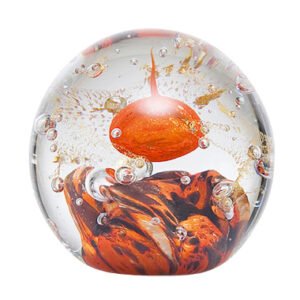
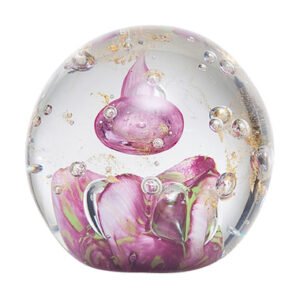
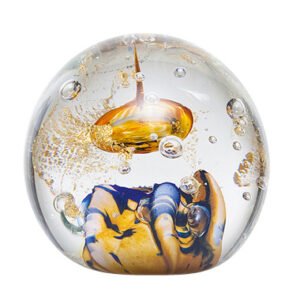
Today, the few artisans still making sulphides are also exploring other possibilities: carefully arranged bubbles, swirling coloured enamels, abstract “universe”-inspired inclusions and unconventional shapes (teardrops, eggs, domes).
Today, the vast majority of prestigious names in French glassmaking, such as Baccarat, Lalique and Daum, no longer produce
Today, the art of making sulphides survives in just a handful of workshops around the world.
Major crystal manufacturers such as Baccarat having stopped production several decades ago, the only sulphides bearing their names are found on the antique market (auctions, antique dealers) or through second-hand resale.
For new sulphides, here is the short list of rare workshops keeping this craft alive:
France’s oldest crystal manufacturer, Saint-Louis is also the only major crystalworks in the world still producing crystal sulphides.
Made in its workshop in the Vosges, often by pre-order, we can safely say that these are among the most luxurious sulphides on the market (starting at €1,960).
While Saint-Louis is the oldest crystalworks in France, La Rochère is, for its part, the oldest glassworks. Still operating since 1475!
And although most of its production is now automated, it continues to make sulphides & paperweights (in crystalline glass) using traditional techniques: mouth-blown and handcrafted.
⇒ Among our recommendations, take a look at the Vérone & Météores collections.
Beyond the big names, a few independent workshops & artisans are still keeping the craft of sulphide making alive. One example is Sabina Glass, a Polish crystalworks we collaborate with, which makes its sulphides entirely by hand.
⇒ Among our recommendations, take a look at their Volcan, Spirale & Tornade sulphides.
It is above all this delicate process, kept alive by just a handful of truly remarkable artisans, that gives these objects their value:
Buying a sulphide today:
❌ Isn’t simply buying a decorative object or a gift.
✅ It’s supporting exceptional craftsmanship that has all but disappeared from Europe in the space of a century.
Step 1: The signature & maker’s mark
Some Saint-Louis pieces have a maker’s mark engraved on the underside. An unsigned piece isn’t necessarily suspicious (many 19th-century workshops didn’t sign their work), but a piece imitating a famous signature almost always is.
Step 2: The finish of the base
The base of a quality sulphide is either fire-polished (smooth and slightly convex) or ground and then polished by hand (perfectly flat, with no roughness or fresh circular scratches). A rough, uneven or poorly finished base reveals rushed workmanship.
Step 3: The centring of the motif
The embedded motif should be perfectly centred within the sphere, without drifting to one side. An off-centre motif suggests that the glassmaker lacked control during the encasing process, which can be a sign of a more “low-end” piece.
Step 4: The clarity of the material
When you hold a sulphide up to the light, the material surrounding the motif should be perfectly clear, with no unwanted bubbles, flow marks or black specks of dust. The only acceptable bubbles in a sulphide are those deliberately incorporated by the glassmaker.
Step 5: Imperfections
Sulphides made in the traditional sense are mouth-blown and handcrafted. As a result, no two pieces are identical, and tiny imperfections may occur. These are not flaws. On the contrary, they are signs of manual & artisanal craftsmanship.
Step 6: The absence of internal cracks
Because a sulphide is made by layering material cooled at different temperatures, internal cracks are the major defect of “low-end” production.
The price depends mainly on three factors: the artisan who made it, the complexity of the motif and the material (crystal vs crystalline glass).
So:
⇒ For small sulphides / paperweights from La Rochère (crystalline glass), expect to pay €25 to €30.
⇒ For more complex pieces, expect to pay around €100.
⇒ And for Saint-Louis sulphides / paperweights (crystal), prices range from €1,960 for entry-level pieces to €6,750 for exceptional creations.
A sulphide is one of the most versatile gifts you can choose from the world of French craftsmanship.
Why?
Because beyond its “rare handcrafted creation” appeal, it is an object with genuine symbolic meaning: a moment frozen within the material.
A unique handcrafted piece to give to someone truly unique in your eyes… making a sulphide a thoughtful gesture rather than a merely practical object.
And the wide range of prices means you can tailor the gift to your needs and wishes:
A prestigious gift to mark a once-in-a-lifetime occasion (wedding, wedding anniversary, birth, retirement)?
⇒ A Saint-Louis sulphide.
A gift for a more “everyday” occasion (Christmas, Mother’s Day, Father’s Day, Valentine’s Day):
⇒ A La Rochère Météores sulphide, Vérone or a spiral sulphide will certainly make an impression.