Free shipping – Breakage protection included – No minimum order
First appearing in the 15th century and perfected in the 16th, the Venetian mirror quickly became a highly coveted masterpiece throughout Europe. Imitated, copied, but never equaled. So much so that Venetian glassmakers who revealed its secrets risked execution. Yet that didn’t stop some of them from being secretly recruited by Louis XIV’s spies, who were determined to uncover the mystery behind this craftsmanship to create a famous… Hall of Mirrors.
More than 340 years later, this exceptional craftsmanship hangs by a thread (or rather… two): because only two families in the Venetian Lagoon still preserve it today, using traditional techniques passed down from generation to generation.
A craft protected by the “Vetro Artistico® Murano” certification, the only official guarantee of authenticity today. And every one of our Venetian mirrors comes from one of these two certified families, guaranteeing that each piece is entirely handcrafted.
For more details, explore our Murano glass page. And to complete your interior with certified pieces, explore our curated selection of Murano glass vases and Murano glass chandeliers.
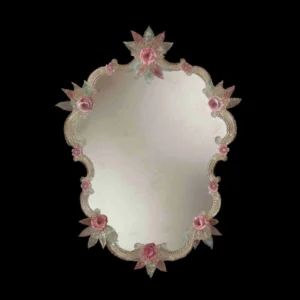
A Venetian mirror (“specchi veneziani” in Italian) is a mirror handcrafted on the island of Murano, in Venice, whose frame (usually made of wood) is covered with panels of blown glass (known as “parcloses”) that are beveled, hand-engraved, and assembled around the central mirror.
Made on the island of Murano, in Venice, after Venetian glassmaking was relocated there in 1291 to prevent fires in Venice itself, these mirrors quickly became popular (and widely imitated) throughout Europe and beyond. Their popularity even prompted the Republic of Venice to take measures to prevent master glassmakers from emigrating and revealing their manufacturing secrets.
Today, thanks to a handful of families who inherited those secrets and revived production, Venetian mirrors remain among the most coveted decorative objects (and unfortunately… among the most frequently copied in the world).
So why did they become so popular?
In particular, because of these 3 features that distinguish them from ordinary mirrors:
1 : The use of Murano glass (for the central mirror as well as certain elements of the frame).
2 : Their magnificent decoration: from deep engravings and crisp geometric shapes to richly ornamented designs (flowers, leaves, rosettes, twisted glass rods), Venetian mirrors are known for being just as much works of art as they are mirrors.
3 : Their handcrafted production: whether it’s the engraving, decoration, beveling, or even silvering… making an authentic Venetian mirror has always been a matter of craftsmanship, born from the artisan’s hands, since the earliest attempts in the 1300s. And Venetian glassmakers have remained, ever since, the only artisans to master the secrets of this art.
An authentic Venetian mirror goes through 6 stages, all carried out by hand, in the same Murano workshop:
Step 1: “Il progetto” (the design)
Everything starts with an idea. The artisan draws the design to scale, taking into account the proportions of the central mirror and its frame.
Step 2: “Il taglio” (the cutting)
Each piece of glass is cut by hand. The rough edges (“fio grezo”) are then polished.
Step 3: “La molatura” (grinding / beveling)
Often called “bizeo”, this is the stage where the edges are beveled using a diamond grinding wheel. The result? Clean, precise edges that capture light like the facets of a gemstone.
Step 4: “L’incisione” (the engraving)
Performed on cold glass, engraving is the visual signature of the Venetian mirror (particularly French-style mirrors). It’s also the stage where the artisan reveals the full extent of a craft unlike any other, as each engraving is made by hand using a small engraving wheel (“rodea”). No two patterns are ever… exactly alike.
Step 5: “L’argentatura/argentà” (the silvering)
Arguably the most important stage of the process, because this is when the glass is “metallized”. In other words, when an ordinary transparent sheet of glass becomes a mirror. To achieve this, the artisan applies a thin layer of reflective metal to the back of the glass, then protects it with a finishing lacquer. This is also when the final appearance changes depending on the finish chosen: “in bianco” (a classic finish for a bright, reflective mirror), “a vecio” (an aged finish for an antique & vintage look) or “a piombo” (a lead-based finish that creates a dark purplish tint and a theatrical effect). This variety of finishes and methods, first of all, allows the artisans to cater to different tastes and preferences. But above all, it reveals the mastery and artisanal excellence of Murano’s glassmakers. That’s what sets your future certified Venetian mirror apart… from soulless, machine-made industrial production.
Step 6, the final stage: “Il montaggio” (the assembly)
This is where the finished Venetian mirror you’ll display in your home finally takes shape. Small decorative nails with glass heads (called “broche”) hold the different pieces together. The result? No visible glue or screws.
Entirely handcrafted, using a sequence of techniques inherited from centuries of tradition, the process can take several days or even weeks. In total, a single Venetian mirror may require dozens or even hundreds of hours of work, depending on the complexity of the design. A large, richly decorated Baroque mirror, for example, can easily keep a workshop busy for several weeks.
And speaking of workshops, let us introduce you to…
We’ve just explored the different stages of production.
Now, let’s meet the artisans who continue to preserve them:
Of the 35 glassmaking workshops certified under the Veneto Region’s official “Vetro Artistico® Murano” label, only 2 specialize in Venetian mirrors.
Knowing these two names means knowing the only sources of authentic Venetian mirrors today:
1 : The Barbini family (AAV Barbini)
Founded in Murano in 1927 by Nicolò Barbini, this workshop belongs to a family whose glassmaking tradition dates back to the 17th century. Even today, it remains a family affair, with two generations working together: Vincenzo and Giovanni, alongside their children Nicola, Marco, Giovanna, Andrea, Pietro, and Filippo. Specializing in the creation and restoration of antique mirrors, their pieces can be found in royal palaces, luxury residences, private villas, and more.
2 : The Ongaro & Fuga family
Founded in 1954 by Franco Fuga and his wife Tullia Ongaro, this crystal house on Calle del Cristo in Murano stands out for its ability to create both classic Venetian-style mirrors and contemporary designs. Their mirrors regularly find their way into luxury hotels, restaurants, and even trains (such as the Orient Express) around the world.
Over time, Venetian mirrors have “branched out” into 3 main styles:
Classic Venetian style (“stile veneziano”):
The historic Baroque mirror, known for its magnificent, richly ornamented designs featuring flowers, leaves, rosettes, and more. Sometimes with subtle touches of gold or silver leaf. Perfect for an interior with a strong personality: a grand townhouse, a classic living room, or a formal dining room.
French style (“stile francese”):
Emerging in the 17th century amid the rivalry between Versailles and Venice, French-style mirrors are generally less ornate. They’re distinguished by understated yet deep engravings and the geometric precision of their beveled edges. An excellent choice for a Haussmann-style, Neoclassical, or sophisticated contemporary interior.
And finally… contemporary style:
Clean lines, understated shapes, a more discreet silhouette… in short, a minimalist approach designed to blend seamlessly into modern interiors.
There are 5 main shapes to consider:
The vertical rectangle:
The most versatile shape. Ideal above a console table or fireplace, or in an entryway.
The oval:
It softens the sharp angles of an overly geometric room, bringing a sense of “gentleness” to the space. Ideal as a bedroom mirror or in a hallway, for example.
The octagon:
Often particularly decorative, this shape is typical of 18th-century Venetian design. It tends to become the star of the room. We’d recommend it for an entryway, for example.
The round mirror:
A more understated shape that, like the oval, brings a calming touch to the space. And because these mirrors are often smaller, they’re perfect for a bathroom, above a sink, for example.
The large Venetian mirror (over 59.1 in):
Now we’re talking about an entirely different scale! Designed for rooms with generous ceiling heights, leave at least 11.8 in between the top of the mirror and the ceiling to preserve its prestigious presence.
In theory, a Venetian mirror can work in any room. But there are still a few rules to follow if you want to avoid a decorating misstep:
The living room:
Above a fireplace, console table, or sofa, this is probably the most popular placement. Because beyond its undeniable decorative appeal, a Venetian mirror can also amplify the light from your chandeliers & lamps.
The dining room:
Ideal above a sideboard or opposite a window, where it can reflect the dining table and enhance the room’s welcoming atmosphere.
The entryway:
Choose a tall, vertical design. While its primary purpose in an entryway is usually decorative (to “set the tone” as soon as someone enters your home), a sufficiently large mirror also lets you make those last outfit adjustments before heading out.
The bedroom:
The same advice applies here: choose a tall, vertical design that lets you see yourself when getting dressed. But opt for more understated styles that don’t feel overly formal. And if you’re simply looking for a decorative mirror, an oval or round design with delicate floral motifs will do beautifully.
The bathroom:
Yes, you absolutely can hang a Venetian mirror in your bathroom (above a sink, as we mentioned earlier)! But there are a few conditions: first, the room needs good airflow and proper ventilation to keep humidity from “attacking” certain parts of the mirror. Second, opt for simple, understated styles. In a bathroom, functionality should generally come before decoration. And one final common-sense tip: never install it directly opposite an open shower without a screen.
Of course:
💡 These are general guidelines. For more specific, personalized advice, please contact us directly.
Let’s be honest with you:
Only experience and a well-trained eye will truly help you tell a genuine Venetian mirror from a fake.
Still, here are a few technical clues that can point you in the right direction (although you’ll obviously need to examine the mirror closely, in person):
Clue 1: The weight
The frame, the decorations, the central mirror: everything is made from thick glass. An authentic Venetian mirror is therefore, by definition, heavy.
Clue 2: The human imperfections
We touched on this earlier when discussing the manufacturing techniques: everything is made by hand. The result? No two decorations or engravings are ever exactly alike or perfectly symmetrical. These slight irregularities are the mark of the artisan’s hand and part of what makes the mirrors so charming: each one is unique, impossible to reproduce exactly. Put simply? Paradoxical as it may sound, if a Venetian mirror looks too “perfect” = be suspicious.
Clue 3: The beveled edges
Hand-ground during the “bizeo” stage, they catch and reflect the light in a lively, distinctive way. If you can’t see this effect, even when the light hits from behind, be cautious.
Clue 4: The “broche” (glass-headed nails)
As a reminder, the mirror and its decorative elements are assembled using small glass-headed nails, gently hammered into place one by one. The result? No visible glue or screws, but the little nails can be seen at the joints. So, once again, if everything looks too “perfect” and nothing is visible = proceed with caution.
And if you can’t examine the mirror in person, 2 additional clues can help:
Clue 5: The price
Probably the easiest clue to spot, because a price that’s too low is a sure sign of a fake (especially when the mirror is being sold new). Between the raw materials, labor, production time, and rarity of these pieces… an authentic Venetian mirror is expensive. Even the simplest models cost several thousand euros at a minimum. So if an “authentic” mirror is being sold for $300/$400… you can be certain it’s a fake.
But be careful:
A high price doesn’t automatically mean a mirror is authentic, either. Many e-commerce sites buy “Venetian-style” mirrors from Asia or North Africa and resell them at a premium through clever marketing.
In summary:
Suspiciously low price = a definite reason for caution.
High price = a positive sign, but don’t rely on that alone.
Clue 6, the final one (the most revealing and the only one that works for a new online purchase when you can’t examine or touch the mirror): the certification.
Online, no photograph can accurately reveal a mirror’s weight, the subtle imperfections of handcraftsmanship, or the glass-headed nails. That leaves just one reliable indicator at a distance: the Vetro Artistico® Murano certification, together with the producing workshop’s identification number. And as we saw earlier, only 2 families of authentic Venetian mirror makers still hold this certification. So it’s hard to claim not to know their certification numbers. Here they are: 097 for the Barbini family and 002 for the Ongaro & Fuga family.
If a website can’t provide these numbers = it’s a scam, 100%.
To learn more about this certification, we explain everything in detail on our Murano glass page.
Bonus advice:
💡 Also be wary of websites that don’t offer a warranty. And those that rely on vague marketing terms such as “Made in Italy”, “Venetian Style” or “Venetian Tradition”. Such phrases are often used to conceal a mirror’s true origin through clever wording.
Between $2,000 and $10,000 for the simplest pieces. And more than $10,000 for large mirrors decorated with 24-karat gold or custom-made designs.
The exact price depends on the size, density of the engraving, decorative details, presence of 24-karat gold leaf, and complexity of the frame. So it’s difficult to give you a narrower price range.
But you get the idea:
Venetian mirrors are expensive pieces… and rightly so! We’re talking about a mirror handcrafted over several hundred hours, unique in the world, and capable of being passed down through generations. In short, a piece with a soul and an identity rooted in more than 500 years of Italian tradition.
The only reliable way to identify a genuine Venetian mirror, especially when buying remotely, is to look for the “Vetro Artistico® Murano” certification, accompanied by the producing workshop’s identification number.
Between 15 and 25 kg for a medium-sized wall mirror (31.5 to 47.2 in), 88 to 154 lbs for a large mirror (59.1–70.9 in), and over 220 lbs for exceptional pieces.
With proper care… indefinitely. Or at least several centuries (if it’s authentic!). Some Venetian mirrors from the 17th century are still displayed in museums and palaces. So with regular maintenance, your mirror can easily last for generations. And if its reflective surface begins to tarnish, workshops such as Barbini can re-silver it and give it a new lease on life.
Dust it regularly with a dry microfiber cloth or a soft feather duster. For stains, clean it with lukewarm water at 30–35°C and a few drops of soft black soap. NEVER use harsh chemicals or household cleaning products, which are far too aggressive. For complete care instructions, consult our dedicated guide.