
Of all the objects made from Murano glass, chandeliers, Venetian mirrors, sculptures, jewelry, and tableware, the vase is one of the pieces that most clearly showcases the skills of the island’s master glassmakers.
Why?
Because, unlike other pieces made in several stages and assembled from separately crafted elements, a vase is often blown and shaped in a single session, over several hours of uninterrupted work around the furnace.
The result?
Everything happens in one session, in full view of everyone.
The vase is also one of the creations that best showcases the island’s signature techniques ↓
Murano glass encompasses around fifty centuries-old decorative techniques, passed down from generation to generation. And while most can be used for all kinds of pieces (chandeliers, sculptures, paperweights, jewelry), some are especially well suited to vases.
Why?
Simply because the walls of a vase offer surface area (and volume), thickness, depth, and transparency all at once.
Of these techniques, here are the 4 you’ll encounter most often in our selection:
Technique #1: Sommerso
This technique involves repeatedly dipping the piece, while the glass is still molten, into several crucibles (a type of container) holding glass in different colors. The result: a magnificent sense of depth, as though several layers of colored material were suspended inside the transparent glass. A technique brought to new heights by Flavio Poli for the Seguso glassworks in the mid-20th century.
Technique #2: Murrine/Millefiori
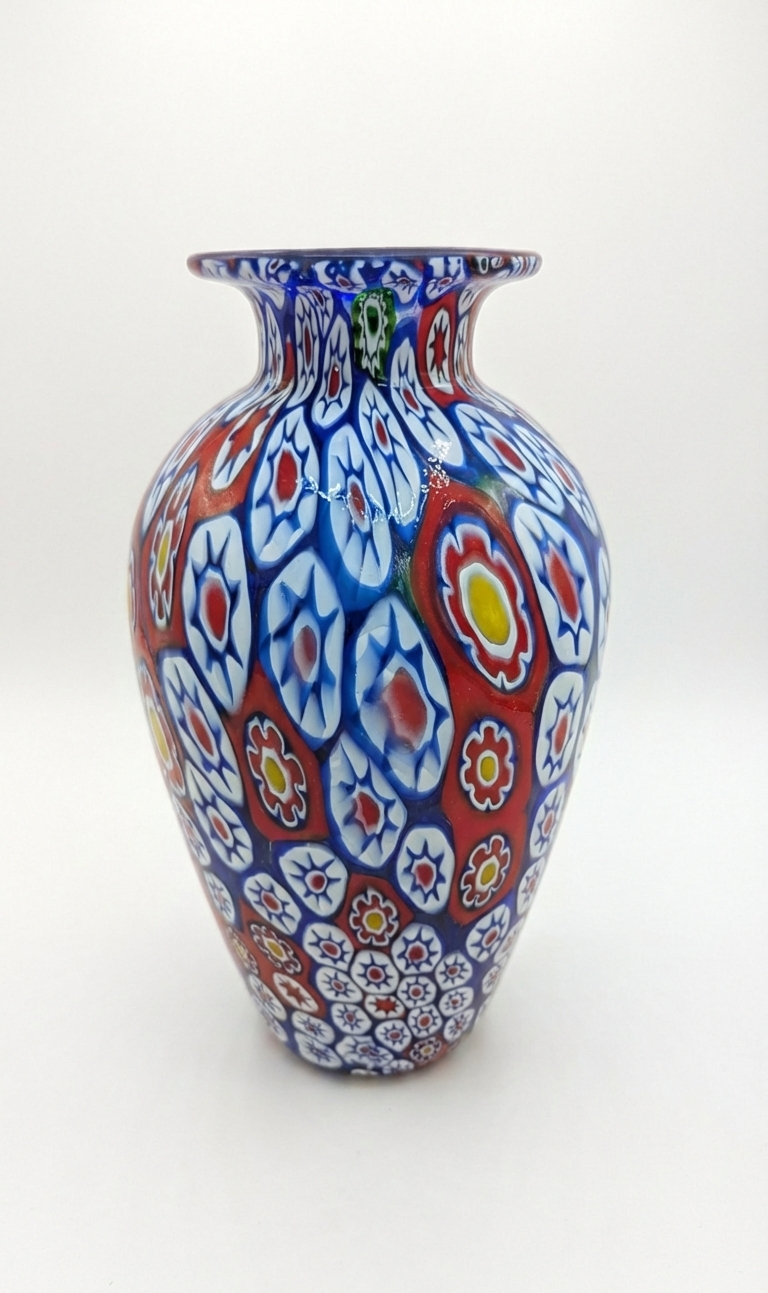
This is probably Murano glass’s best-known technique (particularly for jewelry & paperweights). But the surface of a vase allows it to shine on a much grander scale. How does it work? Colored glass canes are assembled, drawn out while hot, then sliced into thin sections that reveal a pattern (often floral). These small glass pieces are then embedded in the still-molten walls of the vase. The result: a mosaic incorporated into the glass itself, rather than simply applied to its surface.
Just like this “Murrina” vase from the certified La Fornasotta glassworks:
Technique #3: Foglia oro/Foglia argento (gold leaf/silver leaf)
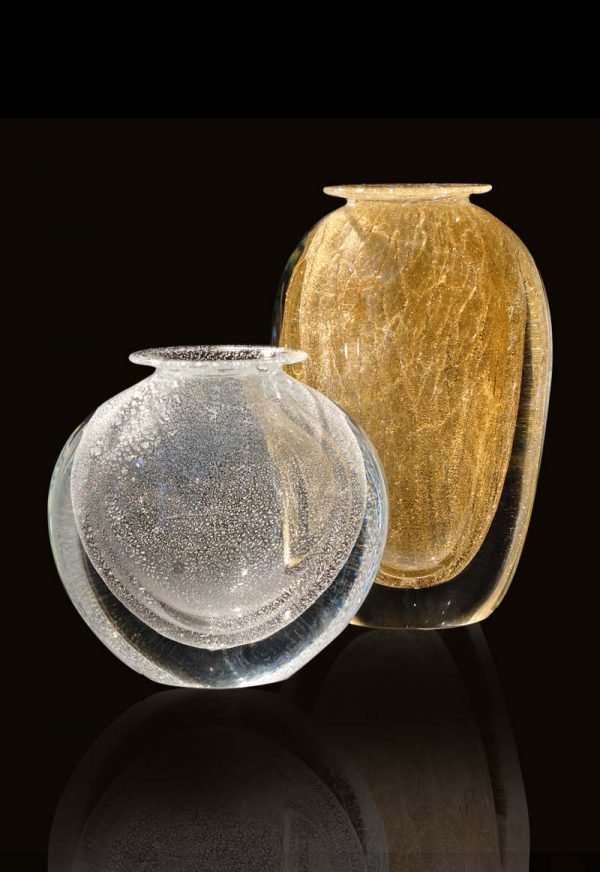
As the names suggest, a sheet (“foglia”) of pure gold or silver is applied to the piece while the glass is still molten, then sealed beneath a layer of transparent glass. During blowing, the leaf breaks into thousands of microscopic fragments, creating the appearance of shimmering gold dust within the glass walls.
Like these “Aurum Argentum” vases from our certified partner glassworks, Fornacemian:
Technique #4: Pulegòso
Derived from the dialect word “púlega”, meaning “little bubble”, this technique involves adding baking soda to molten glass. Why? Because the reaction releases thousands of tiny air bubbles that become trapped in the material. The result? A semi-opaque, almost matte surface. The technique was invented in the 1920s by Maestro Napoleone Martinuzzi, artistic director of the Venini glassworks.
Of course, other techniques (Vetro Incamiciato, Filigrana, Ballottòn) are also used.
Bud vases, flower vases, bowl-shaped vases, sculptural vases, grand statement vases… most Murano glass vase shapes aren’t unique to this material.
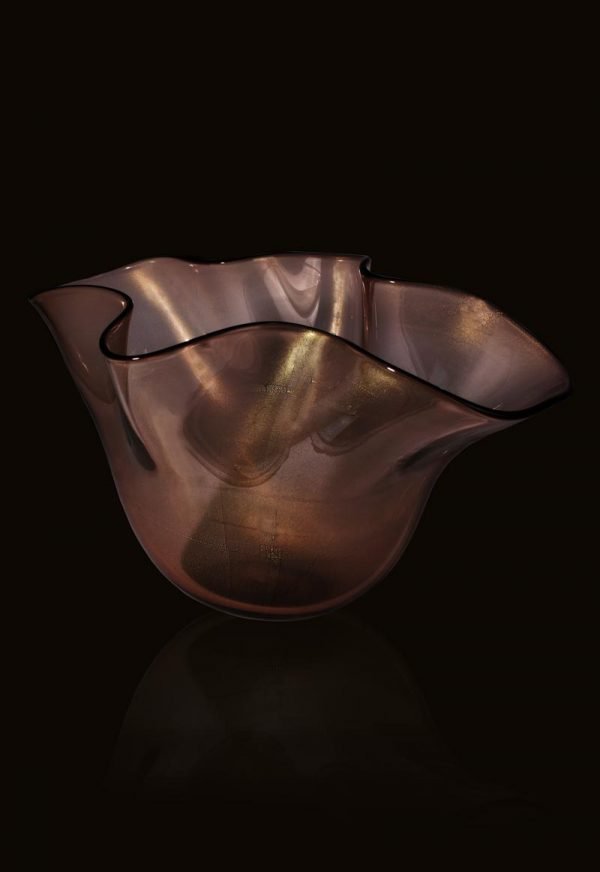
However, one vase shape can truly be attributed to Murano glass: the Fazzoletto.
Literally meaning “handkerchief”, this flared, asymmetrical vase with irregular, wavy edges was invented in 1948 by Fulvio Bianconi and Paolo Venini, two master glassmakers from the Venini glassworks. Its shape evokes a handkerchief tossed into the air and frozen as it falls:
Another shape has also become an archetype of the Murano glass vase: the cane vase (or tapered vase).
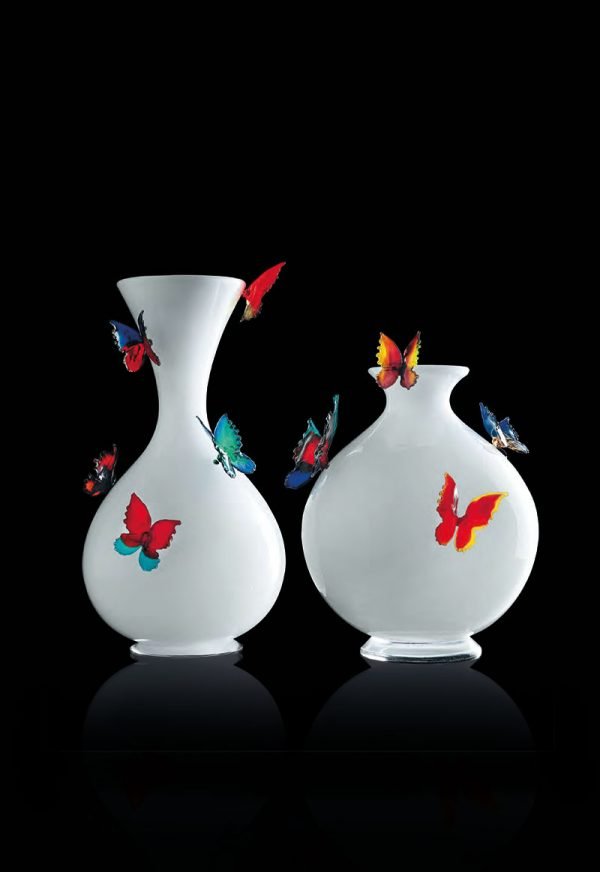
Although this shape can be found in other materials, it’s particularly common in Murano glass. Its flared cylindrical silhouette gives the glassmaker plenty of surface area to showcase decorative techniques: Sommerso, Murrine, and Filigrana.
Like the Murrine vase shown above. Or this “Farfalle” vase from the Fornacemian glassworks:
Murano glass is rarely subtle. The techniques mentioned above are designed to catch the eye, not fade into the background.
So:
If your interior is classic or Haussmannian:
⇒ Choose a colorful Fazzoletto, a cane vase decorated with Murrine, or even a transparent vase with delicate gold threads for a touch of “quiet luxury”.
If your interior is contemporary, minimalist, or understated (neutral palette, natural materials, few patterns):
⇒ A brightly colored (single-color) Sommerso vase or a Foglia oro piece will work beautifully, becoming a natural focal point without overwhelming the space.
And if your interior is Art Deco or eclectic (already rich in patterns, colors, or decorative objects):
⇒ Avoid the previous choices, which might “get lost”. Instead, dare to choose a multicolored Millefiori vase or a polychrome Fazzoletto.
Not every Murano glass vase is suited to holding flowers. So choose according to its intended use:
A vase for flowers?
⇒ Choose a wide-necked vase or a bud vase. And think ahead about the type of flowers (we’ll cover this in more detail below): a bud vase for a single flower, a cane vase for a bouquet, or a Fazzoletto for a low, wide arrangement.
A purely decorative vase?
⇒ The opening matters less. You can opt for more enclosed or sculptural shapes. Instead, focus on the technique: Sommerso, Murrine, Pulegòso, and so on.
Here, there are 3 possibilities:
A single stem:
A transparent Sommerso bud vase will beautifully highlight the stem submerged in water. A classic pairing.
For an airy bouquet:
A cane vase is ideal.
And for a full bouquet (peonies, hydrangeas, or a wildflower arrangement):
Choose a wide-necked vase with minimally decorated walls. Why? Because intricate Murrine patterns can quickly disappear beneath a dense bouquet. And with pieces this beautifully decorated, that would be a real shame.
But above all, remember this tip about height & proportion:
For natural visual balance, aim for flowers that are approximately 1.5 times the height of your vase. Any shorter, and the flowers may look overwhelmed by the vase. Any taller, and the vase may look undersized. Of course, this rule doesn’t apply to bud vases, where exaggerated proportions are part of their charm.


