Free shipping – Breakage protection included – No minimum order

Crystal Champagne Flutes

Champagne is the ultimate French symbol of elegant celebrations, grand gatherings, and exceptional gifts.

And with its slender silhouette, delicate rim, and the nobility of its material, the crystal champagne flute has, over time, established itself as the perfect vessel to elevate the champagne experience.

On this page, you’ll find only premium champagne flutes, glasses & coupes, hand-blown and handcrafted in the finest artisanal tradition. To turn every serving into a little moment of ceremony.

And for a more specialized search, we also distinguish certain origins, crystal manufacturers, and finishes: looking exclusively for Bohemian crystal champagne flutes ? Explore our dedicated curated selection.

Showing the single result

Why choose a CRYSTAL champagne flute?

As we mentioned earlier, champagne is, above all, a reflection of the French art of living that the world has admired for decades.

Refinement, elegance, prestige… qualities and associations far too precious to compromise by drinking it from just any glass.

And the Union des Maisons de Champagne (UMC) is very clear on the matter:

“When it comes to material, glass best meets these requirements, and crystal in particular, praised by André Chénier in his Elegies: crystal of incomparable clarity, crystal with its shifting flashes of light, from which fragrant spirits rise into the air.”

Thanks to its unique properties that enhance the qualities of wine, and its artisanal craftsmanship… crystal is the material of choice for serving your finest champagnes with prestige & elegance.

How to choose your champagne flute… without getting ripped off?

As we’ve just seen, crystal is by far the finest material for enjoying your champagne.

So how can you be sure that the piece you are buying is genuine crystal?

For a complete overview of what to look for, we invite you to read our guide “How to identify genuine crystal”.

But to keep things simple, you have 3 options when shopping online:

  1. Know the leading crystal makers: by purchasing from an established crystal manufacturer (Baccarat, Saint-Louis, or Moser with its renowned lead-free crystal) you can be confident you are buying some of the finest-quality crystal on the market.
  2. Price: an unusually low price is always a sign that the pieces are not genuine crystal. A set of 6 flutes for less than €200–300? You can be sure they are made of glass. Or, at best, crystalline glass.
  3. Composition: it may seem obvious, but always check what the piece is made of. If a website cannot provide this information, consider it a red flag. As for us, most of the pieces we offer are made of lead-free crystal, produced by the Moser crystalworks, the most renowned & prestigious crystal manufacturer in Bohemia. And if you are specifically looking for Bohemian crystal champagne flutes, follow the link to explore our dedicated category.

Champagne flute, coupe, or glass: what is the difference, and which should you choose?

In the French art of living, there are three types of vessels for champagne: flutes, coupes, and glasses.

Three approaches, three uses. And three trends that have evolved over time.

Here is a closer look at their differences to help you choose:

  • The flute:
    With its tall, slender silhouette, it preserves the bubbles and concentrates aromas at the rim. It remains the most popular choice, offering both an enjoyable tasting experience and undeniable elegance.
  • The coupe:
    With its wide, shallow shape, the coupe is, on the other hand, less suited to tasting: its large exposed surface causes the bubbles to dissipate quickly. Even the Union des Maisons de Champagne advises against it, and does not mince words:

    “The coupe, on the other hand, is indefensible. The foam forms poorly and does not last, while the bouquet disperses.” – UMC.

    So why is it still popular?
    There are several reasons:
    First, it is appreciated for its “vintage”aesthetic, which instantly transports us back to the French royal courts, once admired around the world. Or, more recently, to the sophisticated parties of the 1950s, when glamour and sensuality reigned supreme.

    And also,
    of course, because of the famous legend surrounding its creation. A legend that attributes its distinctive shape to the breast of Marie Antoinette. Or that of Madame de Pompadour. These sexy & scandalous stories have only added to the “aura” of the champagne coupe over time.

    The champagne coupe is therefore better known for what it represents
    (celebration, refinement, and the sensuality of the female form)… than for its practical value when tasting champagne.

    Choose it if you want to bring a touch of
    “sexiness” to your celebration, if you are planning a champagne tower for a reception, or if you intend to serve champagne-based cocktails.


  • The “tulip” glass:
    With its rounded bowl and tapered opening, this is the number-one choice for serious champagne enthusiasts. It offers the best balance between concentrating the bouquet and allowing aromas to unfold. It is now the preferred choice of sommeliers and champagne houses:

    “A champagne glass is open enough to allow proper tasting, yet narrow enough to concentrate the bouquet.” – UMC.

In short, which should you choose, and when?

– Choose a champagne glass if you are a true connoisseur seeking the very best tasting experience.

– But in 90% of cases, the flute remains the best compromise between tasting pleasure and an elegant silhouette.

– And save the coupe for special occasions when you want to add a little glamour and sensuality to the celebration.

Serving champagne, a French art of living worth honoring: our essential tips

Champagne is often associated with celebrations and special occasions. But it is also a reflection of the French art of living, admired around the world.

So serving it properly matters. Here are some of our tips, also shared by the Union des Maisons de Champagne:
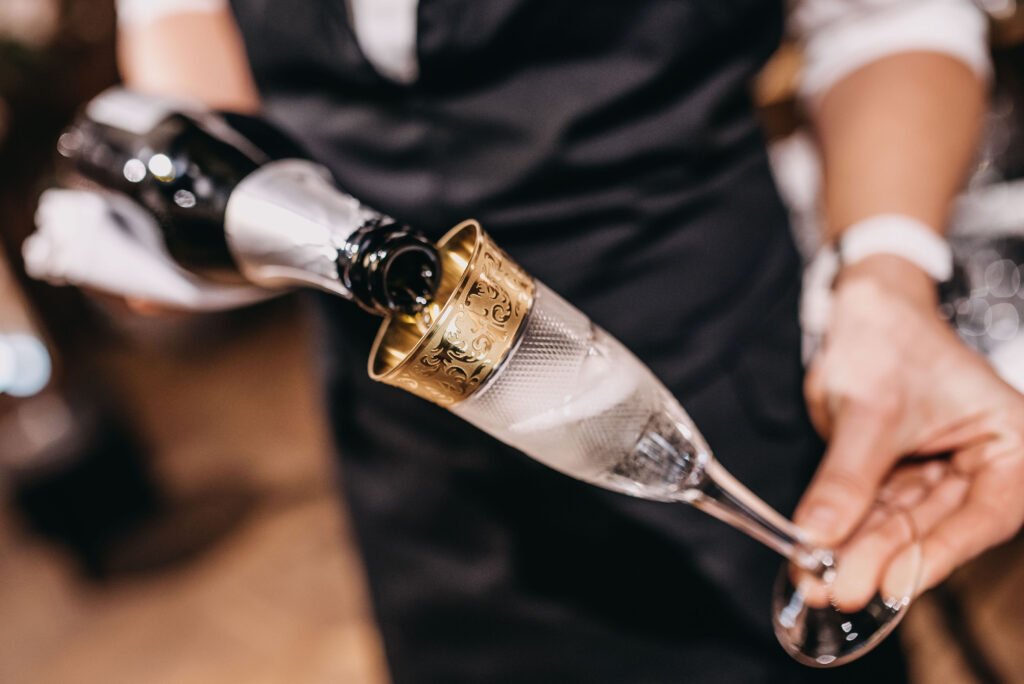
  1. Before serving, opt for a champagne bucket, filled with water and ice. If you do not have one, your refrigerator will do.
  2. When pouring, never tilt the champagne bottle! Instead, tilt the flute at an angle of 15–20°. As well as being more elegant, this helps control the flow, limit foam, and preserve the bubbles.
  3. Another golden rule when serving: fill a champagne flute in 2 pours. And never more than two-thirds full. For a 185 ml flute, that means serving approximately 130 ml of champagne. Depending on the size of your flute, you can serve 8 to 10 flutes from a 1 L bottle, and 18 to 20 from a magnum.
  4. A little bonus tip: use a napkin to hold the end of the bottle and catch any water droplets. Usually a practice reserved for professional servers, but a lovely way to impress your guests 😉 For an example of serving champagne properly, take a look at this server (the flute is from the Splendid collection by Moser) :
  5. After serving, reseal your bottle with an airtight stopper and return it to the champagne bucket.

And what about decanting champagne?

We will let the Union des Maisons de Champagne answer that question directly. As it clearly states on its website:

“Decanting reduces effervescence, one of the vital qualities of champagne […] Serving champagne from a decanter would simply be an attractive ceremony, designed to capture your guests’ attention and heighten their anticipation of being served.“

You get the idea:
Decanting can be useful if you want to add a touch of theater to your evening. But it does nothing to improve the quality of the tasting experience.

How to clean your crystal champagne flutes, glasses, and coupes after serving?

To preserve your flutes, glasses, and coupes for as long as possible, proper care is essential.

Crystal is a delicate material that deserves more than a quick cycle in the dishwasher. It is a princess, and should be treated like one when you clean it.

A few tips to remember:

  • NEVER use the dishwasher, even on a “delicate”cycle. Crystal must be washed by hand. End of story.
  • Never use hot water: crystal is sensitive to thermal shock and extreme temperatures. Avoid hot water and use lukewarm water (30–35°C) with a few drops of black soap, for example (more natural than dish soap (and just as effective).
  • Dry immediately with a clean microfiber cloth to avoid mineral deposits left by the water. To dry the inside of your flute, use a soft bottle brush wrapped in your cloth.
  • ALWAYS store them upright: storing a flute upside down can weaken the connection between the stem and the bowl over time.

To learn more about the art of cleaning crystal, read our dedicated guide: https://cristalartdeco.com/nettoyage-du-cristal/

How much should you expect to pay for quality crystal champagne flutes?

For flutes from major crystal manufacturers, expect to pay around €150 for ONE flute. From smaller crystal manufacturers and independent artisans, you can find a flute for around €80–100.

Please note: we are talking exclusively about hand-blown, handcrafted crystal champagne flutes.

Of course, machine-made flutes in crystalline glass or ordinary glass can easily cost just €5–10 each.