
Free shipping – Breakage protection included – No minimum order
A true symbol of the French art of living, a crystal whiskey decanter is the ultimate tasting accessory for any whiskey enthusiast. It transforms the simple act of serving whiskey into a genuine ritual, while remaining understated thanks to its natural elegance.
Because yes : a whiskey decanter is first and foremost a tasting accessory and a decorative piece… rather than something that offers any real benefit in terms of aeration or aromas, as the SWA (Scotch Whisky Association) likes to remind us.
So, to carry on this tradition of presenting whiskey with refinement and elegance… you’ll find ONLY premium crystal whiskey decanters on this page, hand-blown and hand-cut using centuries-old techniques. Exceptional pieces to elevate the serving experience and impress your guests with creations unlike any other in the world 😉
And to complete your experience, discover the World of our crystal whiskey glasses.
Showing all 4 results
There’s one essential point to understand, because so many people make the same mistake : thinking that a whiskey decanter serves the same purpose as a wine decanter.
WRONG!
And the SWA (Scotch Whisky Association) says so itself :
“Unlike wine, bottled whisky does not improve with age. A decanter is not a tool for maturation, but one for presentation and the short-term release of aromas.”
So here are the real purposes of a whiskey decanter, in order of importance :
– Role No. 1 (the main one) : Aesthetics
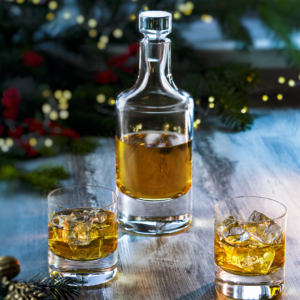
That’s right… contrary to what you read everywhere, the primary purpose of a whisky decanter isn’t to aerate the whiskey. Above all, it’s a beautiful object, with crystal’s transparency revealing the whiskey’s amber color.
For a little context :
This tradition dates back to the 18th century, when whiskey was often sold in casks. Decanters allowed wealthier households to present their whisky more elegantly and affirm their social standing.
– Role No. 1.2: Serving
The second purpose of a whiskey decanter is its practicality in certain respects: its broad base offers greater stability than a bottle, making serving easier.
– Role No. 2 (the secondary one) : Aeration (but only a little)
As we mentioned above with the SWA quotation, a whiskey decanter is a tool for presentation and opening up aromas… but only in the short term. That’s why we consider this a secondary role.
One important distinction: aeration ≠ decanting:
Unlike wine, which contains tannins and continues to evolve… whiskey is a finished product once bottled. As the SWA (Scotch Whisky Association) puts it:
“A 12-year-old whisky kept in a bottle for 100 years will still be a 12-year-old whisky” – SWA.
– Role No. 3: Preserving the last of a bottle
The general rule is that, when a bottle is less than one-third full, you should transfer the remaining whiskey into a suitably sized, airtight decanter. Why? Because this reduces the amount of air in contact with the whiskey and slows oxidation. It’s also advice given by The Macallan distillery for its whiskies.
– Role No. 4: Passing it down
Few people talk about it, but a whiskey decanter (provided it’s made of crystal!) can also become a family heirloom: thanks to its remarkable handcrafted production and proper care… your decanter can last for generations. What could be more beautiful than knowing that one day your son, or even your grandson, will serve his guests while proudly explaining that it belonged to his grandfather? Want to add a personal touch?
We offer engraving on selected pieces!
Although aesthetics are its primary purpose, choosing a whiskey decanter involves more than just how it looks.
Based on our research with industry professionals, four criteria also come into play when it comes to the quality of your experience: capacity, material, stopper seal and stability.
Here’s a short guide to help you choose:
Given that its primary purpose is aesthetic, the impression it creates (and the decorative appeal!)… the style & finish of your decanter are essential.
While this is largely subjective and depends on personal taste, here are a few tips to help you choose according to your interior or intended use:
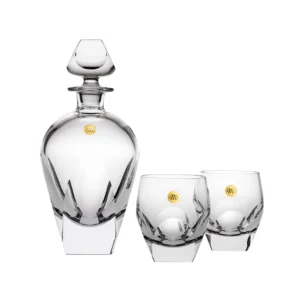
⇒ For classic or period interiors, favour traditional patterns (diamonds, lozenges, flat cuts, fine lines) such as those on our “Bonbon” decanter & whiskey glasses set, for example.
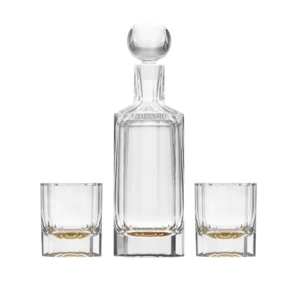
⇒ For contemporary interiors or lovers of understated design, choose a smooth, uncut crystal decanter with a clean, modern style. Such as our decanter from the “Whisky Set” collection, a Moser bestseller since its creation in 1968.
⇒ Is your decanter a gift, and do you want to make a real impression?
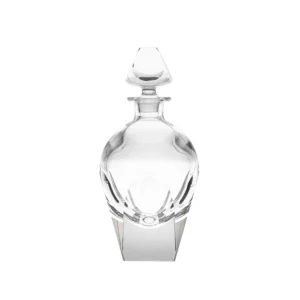
Engraving is an excellent option, although it isn’t always clearly visible depending on the style of the decanter. Another possibility is a collector’s piece, such as our Moser “Bar” set, limited to just 90 pieces WORLDWIDE… forever. Of course, you could just as easily treat yourself… because being able to say at a dinner party that you own “one of only 90 decanters in the world” is quite something!
One little bonus tip:
It may sound obvious, but if you’re putting together a set, choose a decanter and whiskey glasses from the same collection (or with a similar aesthetic) so nothing looks out of place when serving. You’ll find several ready-made sets on this page. Otherwise, take a look at our dedicated selection of crystal whiskey glasses.
Your decanter’s capacity should suit how much whiskey you drink, not the other way around.
Here’s one golden rule to remember:
A whiskey decanter should be filled almost completely, never just halfway. Why? Because the more air there is in contact with the whiskey, the faster oxidation occurs.
Consequently:
⇒ If you only drink whiskey occasionally, opt for a 500–750 ml decanter.
⇒ If you’re a keen whiskey drinker or frequently entertain guests, you can go for a 1 L or 1.5 L decanter.
⇒ And if your decanter is purely decorative, capacity matters little. But avoid filling it with a rare whiskey; choose an everyday blended whiskey instead.
We’re not entirely impartial, we’ll admit it, but crystal remains the benchmark for a whiskey decanter: clarity, brilliance, and a weightier, more “noble” feel in the hand.
So, should you opt for traditional lead crystal or choose lead-free crystal instead?
The rule here is simple:
⇒ For serving or brief aeration (a few hours), traditional lead crystal presents no problem.
⇒ For prolonged storage over several weeks or months, however, choose lead-free crystal, which eliminates the risk of lead leaching into your whiskey. As it happens, that’s exactly what you get with the Moser decanters we offer.
For more information, our article on the composition of crystal is a great place to start.
The stopper is what makes the difference between a decorative decanter and a functional one.
Why?
Because a poorly fitted stopper will continually allow air into your decanter. The result? Your whiskey could lose its aromatic intensity in less than a few weeks.
So if you intend to use your decanter over an extended period, always check how well the stopper fits (or ask the retailer selling it).
Your stopper should fit perfectly, without any sideways movement. Ideally, choose a stopper with a silicone seal or a custom-ground fit (a high-end technique in which the stopper and decanter are polished together to achieve a perfect fit).
This ties in with what we’ve said about the purpose of a decanter, but there are four occasions when decanting your whiskey can be worthwhile:
Before a tasting :
Planning to enjoy a whiskey? Decant it 10 to 30 minutes before serving.
When entertaining :
A decanter is a beautiful accessory, so make the most of it when you have guests! In that case, transfer your whiskey to the decanter only when your guests arrive if you’re serving it as an aperitif. If you’re saving it for later in the evening, decant it during the meal, between the main course and dessert, for example.
To preserve the last of a bottle :
As we mentioned earlier: once your bottle is less than one-third full, transfer the whiskey into a smaller airtight decanter to prevent overly rapid oxidation.
For display & decoration:
That’s another possibility, especially with crystal decanters! But in this case, choose an everyday whiskey, not a rare single-cask expression that deserves better.
Yes… because there are also a few exceptions:
An entire bottle if you won’t drink it soon:
(too much air exposure = faster oxidation)
A very old whiskey:
For whiskies aged over 25 years, it’s best to avoid it. Exposure to air can upset a delicate aromatic balance.
A whiskey that has already been open for several months:
Avoid decanting it in this case too, as it will already have undergone some oxidation. Decanting would only increase that exposure and further diminish its aromas. Of course, if you’re using the decanter purely for decoration, this advice doesn’t apply.
Just like wine, champagne and any other spirit… not all whiskies are created equal, and they shouldn’t all be treated in the same way.
So let’s distinguish the whiskies that benefit most from decanting:
⇒ Cask-strength whiskies (over 50% ABV):
Aeration softens the intensity of the alcohol and releases aromas that ethanol can mask. The textbook example of a whiskey that benefits from decanting.
⇒ Whiskies bottled at over 46% ABV, undiluted and non-chill-filtered. These tend to have rich aromatic profiles that open up with oxygen.
⇒ Powerful young single malts: the aeration from decanting softens their initial sharp alcoholic vapours.
⇒ Intensely peated whiskies: a few minutes of air soften the smoke and reveal the underlying notes.
Whiskies for which decanting offers no benefit (and may even… do more harm than good) :
⇒ Standard blends (around 40% ABV): their profiles are straightforward, without much hidden complexity to reveal. As a result, decanting will be purely aesthetic, so don’t expect anything extraordinary (source: Scotch Whisky Association & WSET).
⇒ Very old, delicate whiskies: as mentioned above, decanting may disrupt their already fragile balance.
⇒ Whiskies that have already oxidised (a bottle that has been open for a long time): as we also explained just above.
Once again, although decanting is primarily about presentation, there are a few steps to follow if you want to do things according to the art of fine living:
1: Prepare your decanter.
It should be clean, dry and completely free of washing-up liquid residue. Follow this guide for cleaning.
2: Pour gently.
Don’t go at it like a bull in a china shop, making a great big “splash”. Introducing air too quickly or aggressively can upset the balance of your whiskey in seconds.
3: Match the decanter’s size to your consumption.
One golden rule to remember: the fuller your decanter, the less air comes into contact with the whiskey = the better it keeps. So choose the size according to how much you drink and how you intend to use it. A well-filled 750 ml decanter is better than a half-full 1.5 L one.
4: Let it rest for 10 to 30 minutes, depending on the whiskey.
The stronger or younger the whiskey, the longer you should leave it. Aim for 30 minutes for the youngsters and 10 minutes for those with a little more age behind them (no pun intended).
5: Always serve at room temperature (18–20°C).
That means avoiding the fridge or an ice bath like the ones used for champagne AT ALL COSTS. Cold temperatures dull whiskey’s aromas.
6: Seal the decanter tightly after serving.
This limits and slows oxidation.
One little bonus reminder:
Finally, remember never to leave your whiskey in the decanter for too long (more than a week and a half) if it’s made of lead crystal. The acidity of whiskey could “attack” the crystal and encourage lead to leach into your drink.
For more information, read our articles on the composition and cleaning of crystal.
But with the lead-free crystal whiskey decanters we offer on this page, there’s no such risk!

