Free shipping – Breakage protection included – No minimum order
A crystal wine decanter (or carafe) is a choice that is as much about aesthetics and symbolism as it is about practicality.
⇒ A wine carafe will perfectly aerate young wines, softening their tannins and revealing their aromas.
⇒ While a wine decanter will help separate older vintages from their sediment.
And what about crystal ?
With its absolute clarity that reveals the wine’s color, its delicate walls that allow the wine to flow effortlessly, its prestigious reputation and its artisanal craftsmanship… it will not only enhance your wine, but also honor the winemakers who have lovingly nurtured it, while impressing your guests with a exceptional piece.
Whether you’re looking for a carafe to aerate your tannic wines or a decanter for your aged vintages, you’ll find only premium crystal wine decanters & on this page. Every piece is hand-blown and handcrafted.
Here, no endless catalogue of low-priced options. Just a curated selection that honors artisanal excellence.
To complete your experience, discover the World of our crystal wine glasses.
First, because crystal offers a real practical advantage:
Its exceptional clarity reveals the true colour of the wine as you serve it, without unwanted reflections. Ordinary glass, by contrast, has slight, but very real, greyish or greenish tints. Especially when exposed to light.
Then, because it offers a truly distinctive feel in your hand:
For a carafe of the same size and shape, crystal is 30% heavier than ordinary glass. A “noble” weight that makes you feel you’re holding more than just an object… you’re holding the result of centuries-old craftsmanship.
And above all, because it’s the only material that truly honours both the wine you’re about to enjoy and the winemakers who crafted it:
You’re opening a 25-year-old classified growth, and you really intend to ruin the experience by pouring it into a mass-produced glass carafe? That’s a choice. Just not ours. At Cristal Art & Déco, we’ve chosen to offer you the very best in artisanal crystal carafes. Just as winemakers offer you the finest in winemaking through their wines. And that same level of craftsmanship can only be found in premium, mouth-blown, handcrafted crystal. As we said on our crystal wine glasses page, crystal is not simply a material… it’s the finishing touch to the winemaker’s work.
Almost everyone outside the wine trade confuses the two. And retailers are often more than happy to take shortcuts in their marketing when it suits them.
Yet there’s a genuine difference you need to know AND understand… or you risk ruining your wine.
Aeration:
Aeration aims to expose a young wine to oxygen to soften its tannins and release its aromas. That’s why you should always use a carafe that maximises contact between wine and air. In other words, one with a wide base, a slightly flared neck and no stopper.
Decanting:
Decanting, on the other hand, is used for older wines to separate them from the sediment they’ve developed over the years. Here, you’ll need a narrow wine carafe (or “decanter”) with a narrow neck and ideally a stopper, to limit contact between wine and air.
An easy way to remember the difference:
⇒ Aeration welcomes air to awaken the wine.
⇒ Decanting protects the wine from air to avoid damaging it.
Of course, it’s impossible to list every wine here, and there are nuances to consider. But here are a few guidelines to help you. In any case, always check with your wine merchant first.
Wines that benefit from aeration include:
⇒ Young Bordeaux wines (predominantly Cabernet Sauvignon or Merlot).
⇒ Young Northern Rhône Syrahs (Côte-Rôtie, Hermitage, Cornas).
⇒ Young, tannic Italian wines (Barolo, Barbaresco, Brunello).
⇒ Full-bodied Languedoc wines and young Bandol (particularly Mourvèdre).
⇒ Rich, complex white wines that are still closed when first opened: great Chardonnays from the Côte de Beaune (Meursault, Puligny, Chassagne), Condrieu/Viognier, white Pessac-Léognan, and structured Loire Chenin Blancs (Savennières, dry Vouvray).
⇒ And wines showing reductive aromas (egg, struck match, sulphur or rubber notes, often found in low-sulphite and natural wines).
How to aerate them:
1 : Always use a crystal wine carafe with a wide base and flared neck.
2 : Pour decisively, allowing the wine to run down the sides of the carafe.
3 : Never put the stopper back in.
4 : As for timing, generally allow 1 to 2 hours before drinking. You can extend this to 2 to 3 hours for Italian wines. But for rich, complex whites, just 30 minutes is enough.
5 : ABOVE ALL, REMEMBER THIS:
If your carafe is made of lead crystal, don’t leave wine inside it between meals, for example. Prolonged contact gives the wine’s acidity time to “attack” the crystal, potentially encouraging lead to leach into your drink.
Wines you should NOT aerate, on the other hand, include:
⇒ All wines aged over 15 to 20 years. A sudden influx of oxygen can upset their balance and cause their bouquet to collapse within minutes.
⇒ Red Burgundy wines (Pinot Noir).
⇒ Southern Rhône wines dominated by Grenache (Châteauneuf-du-Pape, Gigondas, Vacqueyras).
⇒ Light, low-tannin reds such as Beaujolais (Gamay) and Alsace Pinot Noir.
⇒ And highly aromatic, fresh white wines: Riesling, Sauvignon Blanc and particularly crisp, high-acid whites. Aeration can strip away their freshness and lively character.
—
Now, wines that benefit from decanting include:
⇒ Older red wines with visible sediment.
⇒ Mature, structured Bordeaux wines (Médoc, Saint-Émilion, Pomerol) aged between 15 and 25 years.
⇒ Vintage Ports (except very young ones): sediment is virtually inevitable, making decanting almost essential.
⇒ Older Barolo and Barbaresco wines that develop substantial sediment.
⇒ And, more generally, any powerful, tannic, structured wine with enough substance to withstand a little exposure to oxygen during pouring.
And here’s how to decant properly:
1 : Stand the bottle upright for 24 to 48 hours beforehand to allow the sediment to settle.
2 : Always use a narrow crystal wine decanter with a narrow neck and a stopper.
3 : Place a candle beneath the bottle’s neck so you can stop pouring as soon as the sediment approaches the opening (a traditional sommelier technique).
4 : Unlike aeration, pour the wine very slowly and carefully.
5 : Put the stopper back in the decanter.
6 : As for timing, never decant in advance. Do it just before serving.
And wines you should NOT decant, at the risk of ruining them:
⇒ Very old, fragile wines with no visible sediment.
⇒ Mature Burgundies (Pinot Noir) over 20 years old: this delicate, oxidation-sensitive grape variety can be so fragile that transferring the wine may be enough to ruin it.
⇒ Very old Châteauneuf-du-Pape, Bandol and other Grenache-dominant wines.
⇒ And, more generally, any wine that’s past its prime: no amount of decanting will bring a dead wine back to life.
We’ll let the Union des Maisons de Champagne answer that directly:
“Decanting reduces the effervescence, which is one of Champagne’s essential qualities […] Serving it from a carafe would simply be an elegant ritual, capturing your guests’ attention and heightening their anticipation of being served.”
So, as you’ve probably gathered:
Aerating Champagne can be useful if you want to add a little theatre to your evening. But it does nothing to improve the quality of the tasting experience.
When choosing your crystal wine carafe (or decanter), there are 3 things to consider:
Point n°1: The type of wine you drink
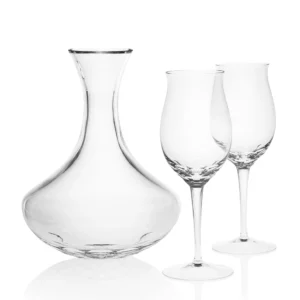
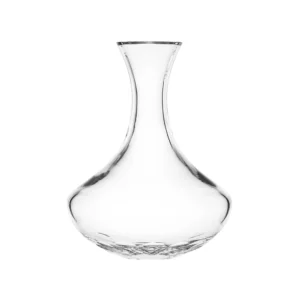
If you mainly drink young, tannic wines, choose a wine carafe with, as a reminder, a fairly wide base and a flared neck. Like this Bouquet carafe by Moser. Also available as a set with two matching red wine glasses.
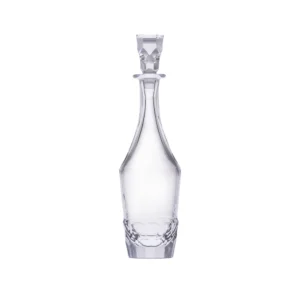
If you prefer mature, aged wines (over 10 to 15 years old), choose a decanter. The rule here is a narrow shape, a narrow neck and a stopper. Like the Pope crystal wine decanter, the Mozart crystal wine decanter, the Sonnet crystal wine decanter, the Maharani crystal wine decanter, the Lady Hamilton crystal wine decanter or the Splendid crystal wine decanter.
Drink both? Then get two carafes. It’s the only honest answer we can give you, because one carafe simply can’t do both jobs properly.
Point n°2: Capacity
Your carafe should have a capacity well above that of your bottle (for aeration). Why? To give the wine enough room to breathe. For decanting, it’s the opposite.
So, for a standard 75cl bottle, aim for a 1L to 1.5L carafe for aeration, and no more than 1L for decanting.
These guidelines should help you avoid the classic mistake of choosing a carafe that’s too large and over-oxidises the wine. Or one that’s too small… and simply defeats the purpose.
Point n°3: Your personal taste
Ultimately, your choice also depends a great deal on your personal taste, the style of your interior and your appreciation of wine tasting.